According to a September 2026 Rabobank report, the current environment for Brazilian orange juice (OJ) remains challenging for both farmers and the industry, with prices still low but starting to show some slightly positive signs. It reported that spot orange prices for the industry increased from BRL 25/box (approximately $4.30/box in U.S. dollars) in May to BRL 31/box (approximately $6.03/box …
Brazilian Psyllid Rate Increases 372%
Psyllid capture rates in São Paulo and the Triângulo/Southwest Minas Gerais region of Brazil rose sharply during the second half of August. The average jumped from 1.3 psyllids per trap in the previous two-week period to 6.13 psyllids per trap — a 372% increase. This spike serves as a warning regarding management of the greening-spreading psyllid, particularly during a time …
Greening Severity Increasing in Brazil
Despite a slowdown in Brazil’s citrus greening incidence growth rate in 2026, the severity of the disease continues to climb in trees remaining in the field, according to Fundecitrus’ annual citrus disease survey. Average severity rose from 22.7% to 27% across orchards of all ages, and from 25.9% to 31% when considering only orchards currently in production. The survey also …
Brazilian Orange Crop Forecast Increased
Fundecitrus’ first re-estimate of the 2026–27 orange crop for Brazil’s São Paulo and Triângulo/Southwest Minas Gerais regions, released Sept. 10, indicates production of 263.15 million 40.8-kilogram boxes. That’s an increase of 7.95 million boxes, or 3.1%, from the initial estimate released in May. The revision stems from an upward adjustment in projected fruit weight for early- and mid-season varieties, which …
Greening Growth Rate in Brazil Slows to Nine-Year Low
The 2026 citrus disease incidence survey conducted by Fundecitrus shows that greening affected 48.08% of orange trees in Brazil’s Citrus Belt spanning São Paulo and the Triângulo/Southwest Minas Gerais regions. This is a 0.9% increase compared to 2025, when the incidence rate was 47.63%. The rise was just 0.45% — significantly lower than the 3.28% increase recorded in 2025. This …
Louis Dreyfus Company to Generate Biogas From Citrus Waste
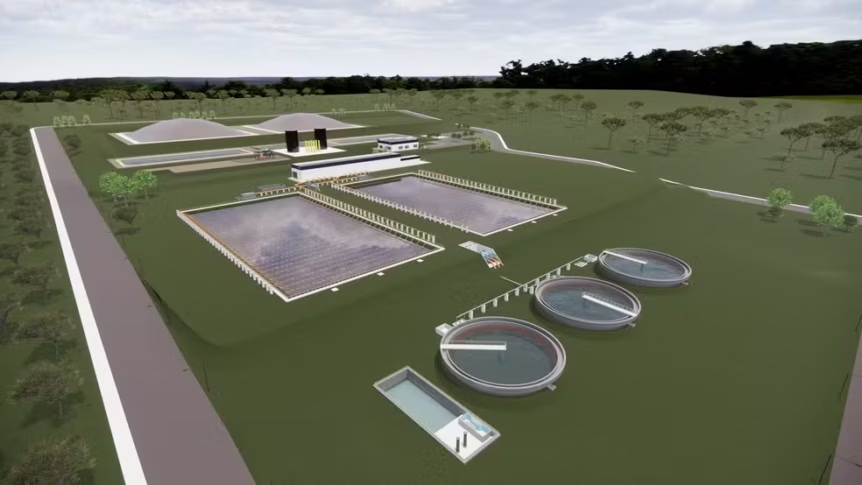
In São Paulo, Brazil, Louis Dreyfus Company (LDC) is constructing what it describes as the world’s largest industrial facility dedicated to generating biogas from citrus effluent. The project, covering more than 2 million square feet, tackles one of the orange juice processing industry’s most significant waste streams by converting organic wastewater into a source of clean, renewable energy. The facility …
Citrus Greening Roundtable Discussion Emphasized Integrated Approach
Representatives from Fundecitrus participated in a recent roundtable discussion about the challenges of combating citrus greening. The roundtable was part of the 44th São Paulo Congress of Phytopathology in Brazil. Participants included Fundecitrus researcher Renato Bassanezi, Technology Transfer Manager Ivaldo Sala and board member Luiz Fernando Girotto, who is an agricultural director at a citrus company. The participants discussed an …
New Research Tool Could Speed Search for HLB Treatments
A new research platform may help scientists identify potential treatments for citrus greening disease faster, potentially speeding up the search for solutions. Citrus greening, also known as huanglongbing (HLB), is caused by the bacterium Candidatus Liberibacter asiaticus (CLas). The disease disrupts the tree’s ability to transport nutrients, leading to symptoms such as blotchy leaves, small and misshapen fruit, poor juice …
The Future of Brazilian Orange Production
Fundecitrus Executive Director Juliano Ayres discussed the future of orange production in Brazil during the 75th-anniversary celebration of the German Fruit Juice Industry Association. The event was held in Bonn, Germany in late June. Ayres addressed the key factors expected to influence Brazilian citrus farming in the coming years, emphasizing orchard health, competitiveness, sustainability and the health benefits of orange …
First Brazilian Variety of Caviar Lime Registered
The state of São Paulo has the first Brazilian variety of caviar lime registered in the National Register of Cultivars. Developed by the Agronomic Institute (IAC), the Faustrime cultivar was registered in 2023 and is expected to reach the market later this year. Faustrime is a hybrid of the Australian finger lime (Microcitrus australasica) crossed with a Eustis limequat. Originating …
Botanical Insecticides Aid in Citrus Greening Management
Brazilian research into botanical insecticides is yielding promising results for managing the Asian citrus psyllid that spreads citrus greening disease. Studies by Fundecitrus show that products based on natural compounds can serve as allies in controlling the psyllid and help reduce resistance to traditional chemical insecticides. TARGETING NYMPHS During the 2024–25 citrus season, more than 30 plant-based products were evaluated …
Brazil Launches Citrus Greening Awareness Campaign
Brazil’s Fundecitrus has launched an awareness campaign — The Fruit of the Orange Tree Is the Progress — to reinforce the need for unity in combating citrus greening disease. The campaign aims to show that orange production extends beyond orchards and the juice industry. Present in hundreds of municipalities, citrus farming drives regional economies, creates direct and indirect jobs, boosts …
Brazilian Orange Tree Inventory Released
Brazil’s Fundecitrus recently released the orange tree inventory of the São Paulo and west-southwest Minas Gerais Citrus Belt. Fundecitrus conducted the inventory in March. Orange orchards occupy 410,974 hectares, an increase of 1.4% from the previous year. Out of this total, the main orange varieties account for 400,260 hectares. The remaining varieties, primarily destined for the fresh fruit market, occupy …
HLB Drives Brazilian Citrus Expansion to New Regions
Brazil’s Fundecitrus on May 28 participated in the Expocitros 2026 lecture session “Focus, Efficiency and Control.” The session focused on the primary phytosanitary challenges facing the Brazilian citrus industry. A session highlight was a lecture by agronomist Ivaldo Sala, coordinator of Fundecitrus’ Technology Transfer Department. Sala’s lecture title was “HLB: How to Proceed in New Citrus-Growing Regions.” Sala said the …
Pressures Impacting the Brazilian Citrus Industry
Shifts in the international geopolitical landscape, rising logistics costs, sanitary barriers and currency fluctuations are directly impacting Brazil’s fruit industry, including citrus. The effects of these transformations were discussed during a recent edition of the Socioeconomics Debates series, hosted by Embrapa, under the theme, Brazil’s Fruit Industry: How Global Crises Impact What Reaches Your Table. Researchers, economists and production representatives …
Edge Topping in Brazil: Opportunity and Caution
Topping — pruning the tops of trees — along orchard edges has been studied as a potential strategy for managing citrus greening disease. This technique aims to stimulate new shoot growth on trees along the orchard perimeter to attract the psyllid — the insect vector responsible for transmitting the disease. Chemical control efforts can then be concentrated in those specific …
Brazil’s 2026–27 Orange Forecast Issued
Brazil’s Fundecitrus on May 8 forecast 2026–27 orange crop production for the Citrus Belt of São Paulo and the Triângulo/Southwest Minas Gerais region at 255.2 million 40.8-kilogram boxes. That’s a 12.9% reduction from the previous crop of 292.94 million boxes and a 14.7% decline relative to the average of the last decade. REASONS FOR LESS ORANGES The projection for lower …
Orange Pulp Gains Status as Valuable Raw Material
Orange pulp — long treated as a waste product of the citrus industry — has been gaining new status as a valuable raw material. Composed of peels, seeds and fibers, this material — previously destined primarily for animal feed — is also known as citrus bagasse. Brazilian citrus association Fundecitrus reports that companies in the citrus industry have been investing …
Final Brazil Orange Forecast for 2025–26
Fundecitrus on April 10 reported the final forecast for the 2025–26 orange crop for Brazil’s São Paulo and West-Southwest Minas Gerais Citrus Belt. The forecast is for 292.94 million 90-pound boxes. Of the total, about 25.69 million boxes were produced in the Triângulo Mineiro region. Production this season was 26.9% higher than the previous crop, which reached 230.87 million boxes. …
Cover Crops, Ecological Mowing Benefit Citrus
Brazil’s Fundecitrus reported on the benefits to citrus from the use of perennial cover crops such as Urochloa ruziziensis combined with the adoption of ecological mowing. This technology has been gaining space in groves by redistributing the phytomass of cover crops from the interrows to the planting rows, forming a protective mulching layer over the soil. Benefits of the management …